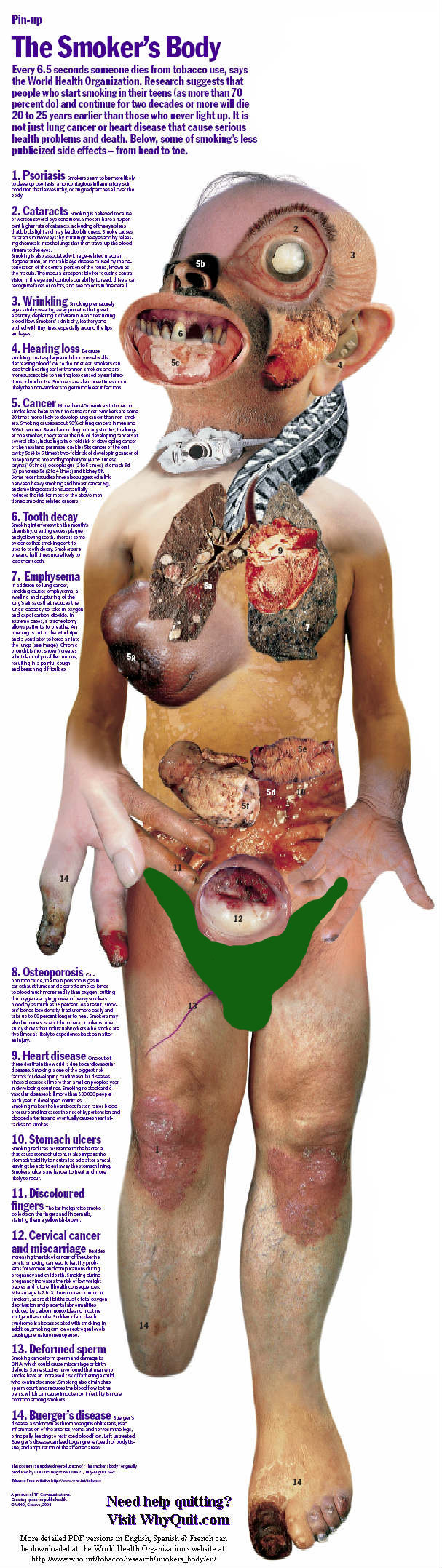
Research has shown conclusively that smoking accelerates arteriosclerosis (hardening of the arteries) and atherosclerosis (a type of arteriosclerosis characterized by fatty deposits in the artery walls), increasing the risk of heart disease, stroke, and peripheral vascular disease. Consequently, smokers have a higher risk of cardiovascular disease in general, and heart attacks in particular, than nonsmokers.
Cigarettes may promote atherosclerosis by a va- riety of mechanisms. Smoking increases the levels of carbon monoxide, a poisonous gas that is inhaled in smoke. Over the long term, this increased level of carbon monoxide from the inhaled smoke itself contributes to damaging the lining of the blood vessels and accelerates the process of atherosclerosis.
Smoking also affects serum cholesterol. Smokers tend to have decreased levels of high-density lipoproteins (HDL—the “good cholesterol) and increased levels of low-density lipoproteins (LDL-the “bad’ cholesterol) and triglycerides (a blood fat), thereby raising the risk and severity of atherosclerosis.
Blood levels of fibrinogen, a component of blood necessary for clotting, are raised by smoking. This may increase the likelihood of blood clots forming and blocking the coronary arteries, leading to a heart attack or stroke. Such clots are most likely to form on areas of the endothelium (the inner lining of blood vessel walls) that are clogged by atherosclerotic plaque and have been roughened by prior damage, rather than on those that remain smooth and intact. Smoking may also cause blood platelets to clump abnormally, adding to the risk of clotting.
Stopping smoking results in an increase in the ratio of HDL to LDL cholesterol and lowers the level of fibrinogen in the blood. Both of these changes help reduce the risk of a heart attack.